
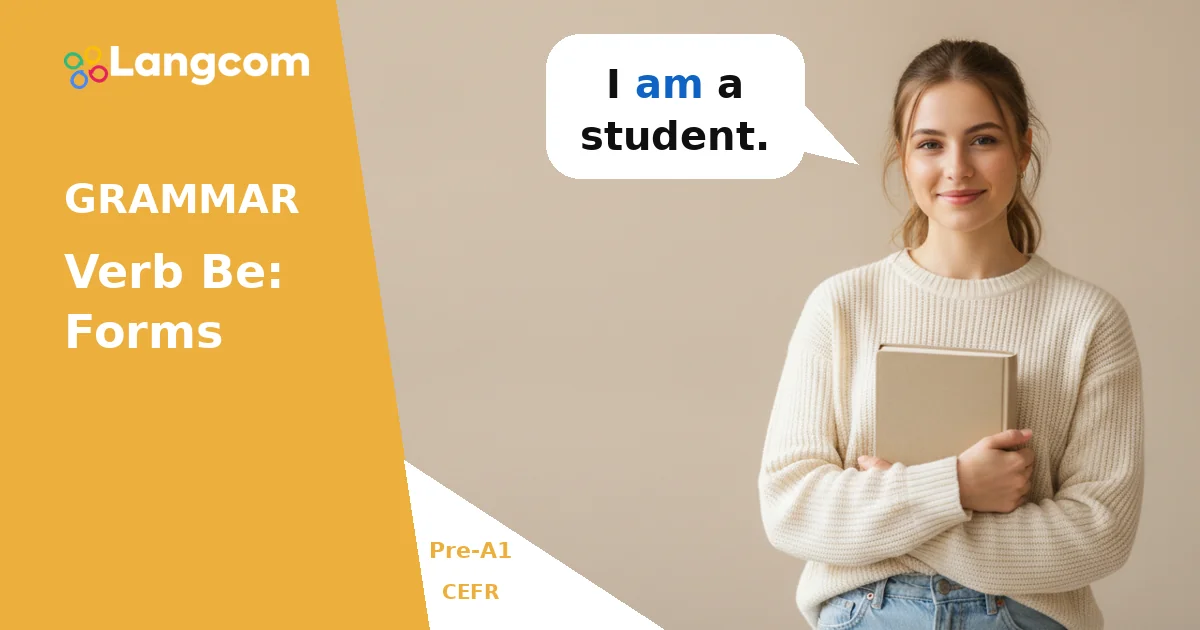

What is the English verb To Be?
The verb to be is very common in English. It helps us talk about many things.
- It means “ser” or “estar” in Spanish.
- It tells us about identity, age, feelings, and location.
In the present simple, to be has three forms: am, is, et are.
🎓 Apprenez l'anglais grâce à la méthode mixte
Petits groupes · Tuteur IA disponible 24 h/24, 7 j/7 · Préparation aux examens de Cambridge
Plans provenant de $39 $79 par mois
How do we use Am, Is, and Are?
The form of to be changes with the subject. This is called subject-verb agreement.
- Use am only with the pronoun I.
- Use is with he, she, it, and singular nouns (like “the dog” or “my friend”).
- Use are with you, we, they, and plural nouns (like “the students” or “my parents”).
When do we use the verb To Be?
We use am, is, are for many different situations.
- To say who someone is or what something is (Identity):
- I am a student.
- He is a doctor.
- It is a book.
- To say how old someone is (Age):
- I am ten years old.
- She is twenty.
- To describe feelings or states (Feelings/States):
- We are happy.
- He is tired.
- To say where someone or something is (Location):
- They are at home.
- The cat is on the chair.
- To describe people or things (Description):
- The weather is cold.
- You are very kind.
What are the short forms of To Be?
In spoken English and informal writing, we often use short forms, called contractions. They make sentences shorter and faster.
- I am becomes I’m
- He is becomes He’s
- She is becomes She’s
- It is becomes It’s
- You are becomes You’re
- We are becomes We’re
- They are becomes They’re
These short forms are very common. Try to use them!
| Subject | Verb Form | Example |
|---|---|---|
| I | am | I am happy. |
| He | is | He is a boy. |
| She | is | She is my sister. |
| It | is | It is cold. |
| You | are | You are smart. |
| We | are | We are friends. |
| They | are | They are students. |
Exemples
- I am a student.
- She is happy.
- They are at school.
- He is ten years old.
- We are friends.
- It is a big dog.
Entraînement
💬 Vous avez besoin de conseils personnalisés ?
En tant que centre de préparation agréé par Cambridge, nous pouvons vous aider à choisir la formation et la certification qui vous conviennent. Discutez-en dès aujourd'hui avec nos conseillers.
Discutez avec un conseiller sur WhatsAppErreurs courantes chez les hispanophones
Spanish speakers sometimes make mistakes with to be because of differences between English and Spanish.
- Using have for age: In Spanish, you use “tener” (to have) for age. In English, we use to be.
- Wrong: I have ten years.
- Correct: I am ten years old.
- Forgetting to be: In Spanish, sometimes the verb “ser” or “estar” is implied. In English, you always need to be.
- Wrong: He happy.
- Correct: He is happy.
- Confusing is et are: Remember is is for one person/thing, are is for more than one.
- Wrong: My parents is at home.
- Correct: My parents are at home.
Questions fréquemment posées
What are the three forms of To Be in the present?
The three forms are am, is, et are.
When do I use Am?
You use am only with the subject I, for example, I am a student.
Can I use Is for “you”?
No, you must use are for you. For example, You are nice.
What is the short form of they are?
The short form of they are is they’re.
Does To Be mean “tener” for age?
No, to be means “ser” or “estar”. For age, English uses to be, not have. For example, I am twelve years old.

0 commentaire