
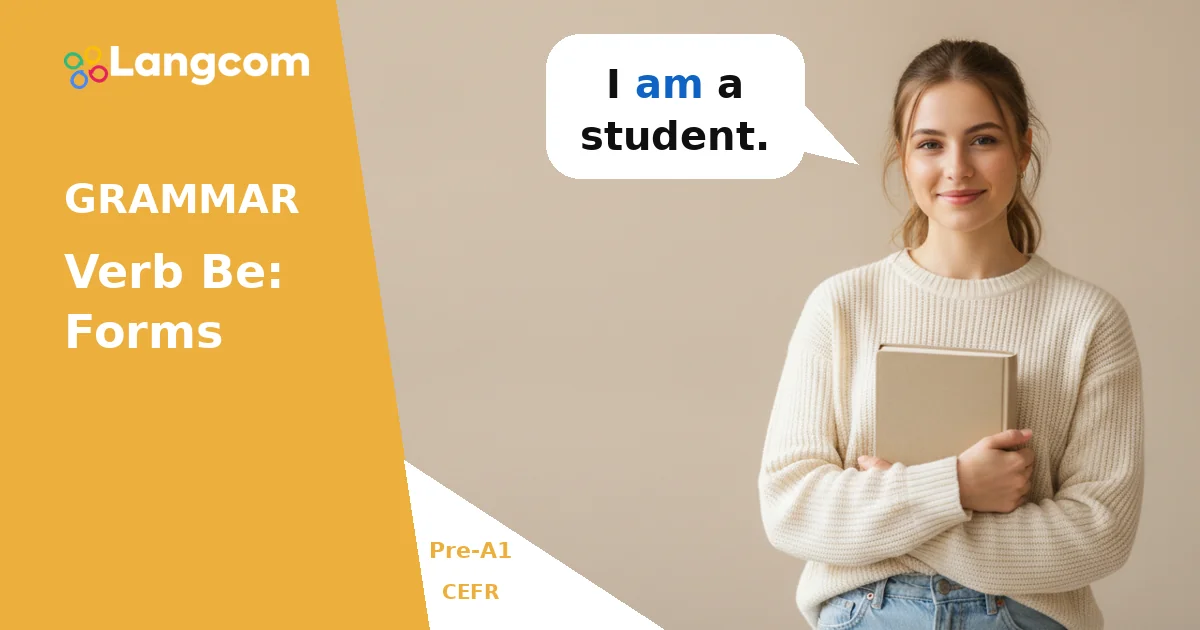

What is the English verb To Be?
الفعل to be is very common in English. It helps us talk about many things.
- It means “ser” or “estar” in Spanish.
- It tells us about identity, age, feelings, and location.
In the present simple, to be has three forms: am, is, ، و are.
🎓 تعلم اللغة الإنجليزية باستخدام الطريقة المختلطة
مجموعات صغيرة · مدرس ذكاء اصطناعي متاح على مدار الساعة · التحضير لامتحانات كامبريدج
خطط من $39 $79 في الشهر
How do we use Am, Is, and Are?
The form of to be changes with the subject. This is called subject-verb agreement.
- Use am only with the pronoun I.
- Use is مع he, she, it, and singular nouns (like “the dog” or “my friend”).
- Use are مع you, we, they, and plural nouns (like “the students” or “my parents”).
When do we use the verb To Be?
نحن نستخدم am, is, are for many different situations.
- To say who someone is or what something is (Identity):
- I am a student.
- He is a doctor.
- It is a book.
- To say how old someone is (Age):
- I am ten years old.
- She is twenty.
- To describe feelings or states (Feelings/States):
- We are happy.
- He is tired.
- To say where someone or something is (Location):
- They are at home.
- The cat is on the chair.
- To describe people or things (Description):
- The weather is cold.
- You are very kind.
What are the short forms of To Be?
In spoken English and informal writing, we often use short forms, called contractions. They make sentences shorter and faster.
- I am becomes I’m
- He is becomes He’s
- She is becomes She’s
- It is becomes It’s
- You are becomes You’re
- We are becomes We’re
- They are becomes They’re
These short forms are very common. Try to use them!
| الموضوع | Verb Form | Example |
|---|---|---|
| I | am | I am happy. |
| He | is | He is a boy. |
| She | is | She is my sister. |
| It | is | It is cold. |
| You | are | You are smart. |
| We | are | We are friends. |
| They | are | They are students. |
أمثلة
- I am a student.
- She is happy.
- They are at school.
- He is ten years old.
- We are friends.
- It is a big dog.
التدريب
💬 هل تحتاج إلى إرشادات مخصصة؟
بصفتنا مركزًا معتمدًا للتحضير لاختبارات كامبريدج، يمكننا توجيهك نحو الدورة والشهادة المناسبتين لك. تحدث مع مستشارينا اليوم.
دردش مع مستشار على واتسابالأخطاء الشائعة لدى المتحدثين باللغة الإسبانية
Spanish speakers sometimes make mistakes with to be because of differences between English and Spanish.
- استخدام have for age: In Spanish, you use “tener” (to have) for age. In English, we use to be.
- Wrong: I have ten years.
- Correct: I am ten years old.
- Forgetting to be: In Spanish, sometimes the verb “ser” or “estar” is implied. In English, you always need to be.
- Wrong: He happy.
- Correct: He is happy.
- مربك is و are: Remember is is for one person/thing, are is for more than one.
- Wrong: My parents is at home.
- Correct: My parents are at home.
الأسئلة الشائعة
What are the three forms of To Be in the present?
The three forms are am, is, ، و are.
When do I use Am?
أنت تستخدم am only with the subject I, for example, I am a student.
Can I use Is for “you”?
No, you must use are for you. على سبيل المثال،, You are nice.
What is the short form of they are?
الصيغة المختصرة لـ they are هو they’re.
Does To Be mean “tener” for age?
لا،, to be means “ser” or “estar”. For age, English uses to be, ، وليس have. على سبيل المثال،, I am twelve years old.

0 تعليق