

What are ‘Activities’ in English?
Activities are things you do. They can be for fun, for exercise, or just things you do every day.
In English, we use special words called verbs to talk about these actions.
🎓 Learn English with the Blended method
Small groups · 24/7 AI Tutor · Cambridge preparation
Plans from $39 $79 per month
Common Verbs for Fun Activities
Let’s learn some important verbs for common activities. These words help you describe what you like to do.
-
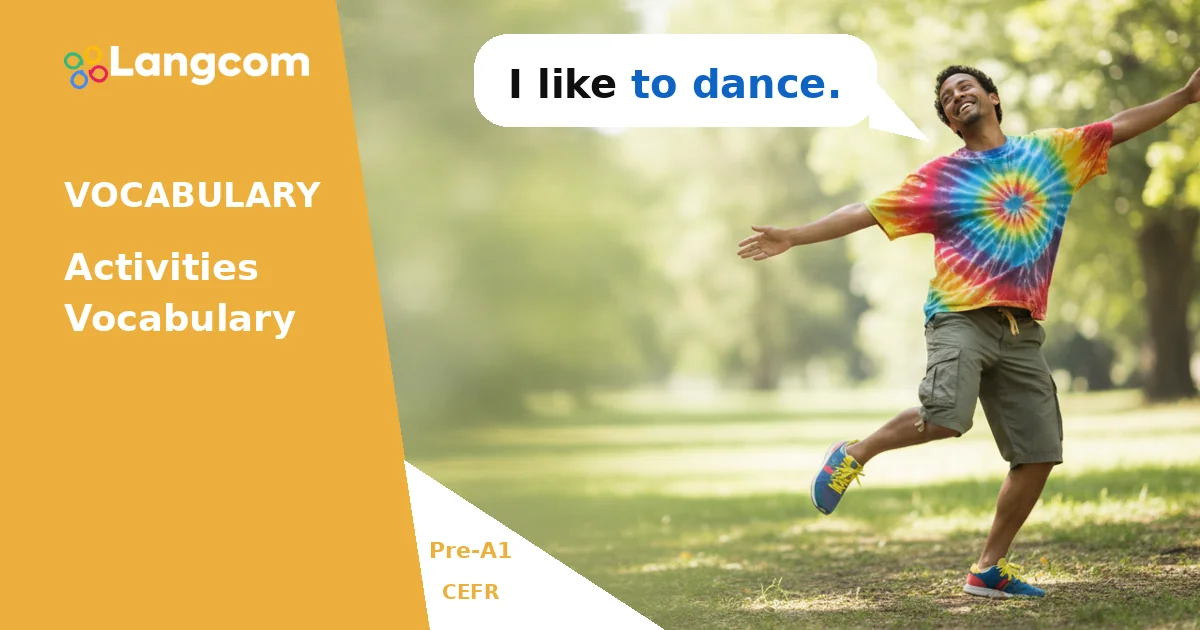
Dance: This means to move your body to music. I like to dance.
-
Act: This means to perform in a play or movie. She wants to act.
-
Sing: This means to make music with your voice. He can sing very well.
-
Cook: This means to prepare food. My mom likes to cook.
-
Swim: This means to move in water. We swim in the pool.
-
Dive: This means to jump into water with your head first. He can dive from the board.
-
Ride a bike: This means to use a bicycle. They ride a bike in the park.
Using ‘Play’ for Sports and Instruments
The verb play is very common for many activities, especially sports and musical instruments.
-
Play tennis: This is a sport with a racket and a ball. Do you play tennis?
-
Play basketball: This is a team sport with a ball and a hoop. I play basketball every Saturday.
-
Play the guitar: This is a musical instrument. She can play the guitar.
| Verb | Example Sentence |
|---|---|
| dance | I like to dance. |
| act | She wants to act. |
| sing | He can sing. |
| cook | My mom likes to cook. |
| swim | We swim in the pool. |
| dive | He can dive. |
| ride a bike | They ride a bike. |
| play tennis | Do you play tennis? |
| play basketball | I play basketball. |
| play the guitar | She plays the guitar. |
Examples
- I like to dance.
- He can sing.
- We play basketball.
- She rides a bike.
- My friend can cook.
- They swim in the ocean.
Practice
💬 Need personalized guidance?
As an Authorized Cambridge Preparation Centre, we can guide you to the right course and certification. Chat with our advisors today.
Chat with an Advisor on WhatsAppCommon mistakes for Spanish speakers
Using ‘Do’ instead of ‘Play’
Many Spanish speakers sometimes use do for sports or instruments, like I do tennis. This is not correct in English.
- Incorrect: I do play tennis.
- Correct: I play tennis.
Always use play for sports and musical instruments.
Frequently asked questions
What is an activity?
An activity is something you do, often for fun or as a hobby. For example, sing and play tennis are activities.
How do I say ‘I like to…’ with these verbs?
You can say I like to + the verb. For example, I like to cook or I like to swim.
Can I use ‘play’ for all sports?
For many sports, yes! You use play for sports like play tennis, play basketball, play soccer. But for some activities, we use other verbs, like go swimming or do yoga.
What is the difference between ‘swim’ and ‘dive’?
Swim means to move through water using your body. Dive means to jump into the water, usually head first, often from a high place.



0 Comments