
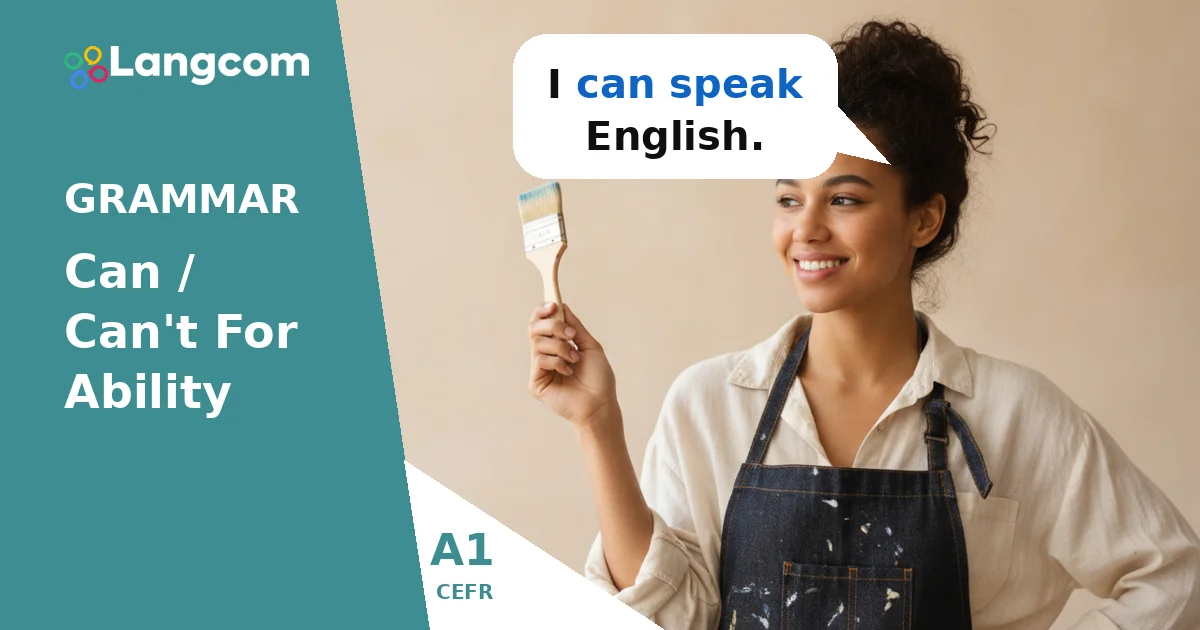

What Does ‘Can’ Mean in English?
Can is a modal verb. We use it to talk about ability. It means ‘poder’ in Spanish.
Вы используете can to say that someone has the skill or the possibility to do something.
🎓 Изучайте английский по смешанной методике
Небольшие группы · ИИ-репетитор 24/7 · Подготовка к экзаменам Кембриджского университета
Планы от $39 $79 в месяц
How to Use ‘Can’ for Positive Ability (+)
To say what someone can do, follow this simple structure:
- Subject + can + base form of the verb
The base form of the verb is the infinitive without ‘to’. For example, swim, а не to swim.
How to Use ‘Can’t’ for Negative Ability (-)
To say what someone cannot do, or does not have the ability to do, use can’t.
Can’t is the short form of cannot. It is very common in spoken and written English.
- Subject + can’t + base form of the verb
Remember: ‘Can’ is Special!
Can is a modal verb, so it has special rules:
- It does not change for he, she, или it. You do not add -s.
- You always use the base form of the next verb. Do not use to before the verb.
- You do not use do или does with can for negatives. Just use can’t.
| Тема | Positive (+) | Negative (-) |
|---|---|---|
| I | can speak | can’t speak |
| You | can speak | can’t speak |
| He/She/It | can speak | can’t speak |
| We | can speak | can’t speak |
| They | can speak | can’t speak |
Примеры
- I can speak English.
- You can play the guitar.
- He can run fast.
- She can sing beautifully.
- It can fly.
- We can help you.
- They can understand Spanish.
- I can’t swim.
- You can’t see me.
- He can’t drive a car.
- She can’t lift heavy boxes.
- It can’t talk.
- We can’t go today.
- They can’t hear the music.
Практика
💬 Нужна индивидуальная консультация?
Являясь официальным центром подготовки к экзаменам Кембриджского университета, мы поможем вам выбрать подходящий курс и программу сертификации. Свяжитесь с нашими консультантами уже сегодня.
Общайтесь с консультантом в WhatsAppРаспространенные ошибки у носителей испанского языка
Spanish speakers sometimes make these mistakes with can:
- Adding ‘to’ after can:
❌ I can to swim.
✅ I can swim. - Adding ‘-s’ for he/she/it:
❌ She cans play tennis.
✅ She can play tennis. - Использование don’t или doesn’t for negatives:
❌ I don’t can speak French.
✅ I can’t speak French.
Часто задаваемые вопросы
What is the meaning of ‘can’?
Can means ‘poder’ in Spanish. We use it to express ability or possibility.
Does ‘can’ change for he/she/it?
No, can does not change. It is always can for all subjects (I, you, he, she, it, we, they).
What verb form comes after ‘can’ or ‘can’t’?
You always use the base form of the verb (the infinitive without ‘to’) after can или can’t. Например, can run, а не can to run.
What is the short form of ‘cannot’?
Сокращённая форма cannot является can’t. It is very common in everyday English.



0 Комментариев