
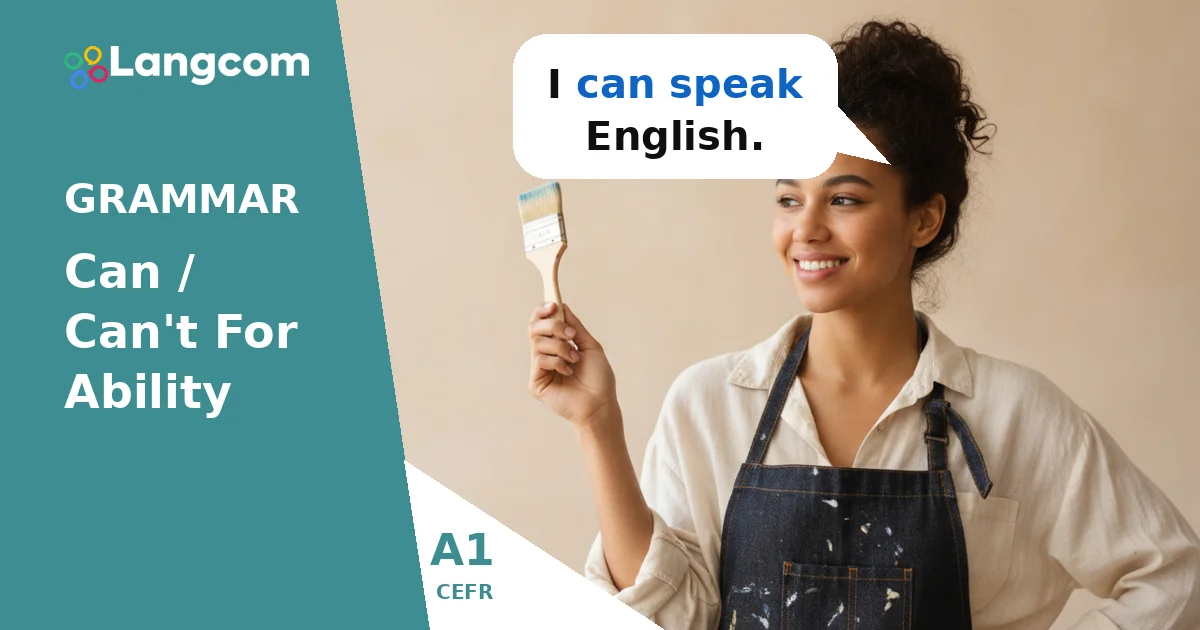

What Does ‘Can’ Mean in English?
Can is a modal verb. We use it to talk about ability. It means ‘poder’ in Spanish.
You use can to say that someone has the skill or the possibility to do something.
🎓 Aprenda inglês com o método misto
Grupos pequenos · Tutor de IA 24 horas por dia, 7 dias por semana · Preparação para os exames de Cambridge
Planos de $39 $79 por mês
How to Use ‘Can’ for Positive Ability (+)
To say what someone can do, follow this simple structure:
- Subject + can + base form of the verb
The base form of the verb is the infinitive without ‘to’. For example, swim, not to swim.
How to Use ‘Can’t’ for Negative Ability (-)
To say what someone cannot do, or does not have the ability to do, use can’t.
Can’t is the short form of cannot. It is very common in spoken and written English.
- Subject + can’t + base form of the verb
Remember: ‘Can’ is Special!
Can is a modal verb, so it has special rules:
- It does not change for he, she, ou it. You do not add -s.
- You always use the base form of the next verb. Do not use to before the verb.
- You do not use do ou does with can for negatives. Just use can’t.
| Subject | Positive (+) | Negative (-) |
|---|---|---|
| I | can speak | can’t speak |
| You | can speak | can’t speak |
| He/She/It | can speak | can’t speak |
| We | can speak | can’t speak |
| They | can speak | can’t speak |
Exemplos
- I can speak English.
- You can play the guitar.
- He can run fast.
- She can sing beautifully.
- It can fly.
- We can help you.
- They can understand Spanish.
- I can’t swim.
- You can’t see me.
- He can’t drive a car.
- She can’t lift heavy boxes.
- It can’t talk.
- We can’t go today.
- They can’t hear the music.
Prática
💬 Precisa de orientação personalizada?
Como Centro Autorizado de Preparação para os Exames de Cambridge, podemos orientá-lo na escolha do curso e da certificação mais adequados. Entre em contato com nossos orientadores hoje mesmo.
Converse com um consultor pelo WhatsAppErros comuns entre falantes de espanhol
Spanish speakers sometimes make these mistakes with can:
- Adding ‘to’ after can:
❌ I can to swim.
✅ I can swim. - Adding ‘-s’ for he/she/it:
❌ She cans play tennis.
✅ She can play tennis. - Using don’t ou doesn’t for negatives:
❌ I don’t can speak French.
✅ I can’t speak French.
Perguntas frequentes
What is the meaning of ‘can’?
Can means ‘poder’ in Spanish. We use it to express ability or possibility.
Does ‘can’ change for he/she/it?
No, can does not change. It is always can for all subjects (I, you, he, she, it, we, they).
What verb form comes after ‘can’ or ‘can’t’?
You always use the base form of the verb (the infinitive without ‘to’) after can ou can’t. Por exemplo, can run, not can to run.
What is the short form of ‘cannot’?
The short form of cannot é can’t. It is very common in everyday English.


0 Comentários