
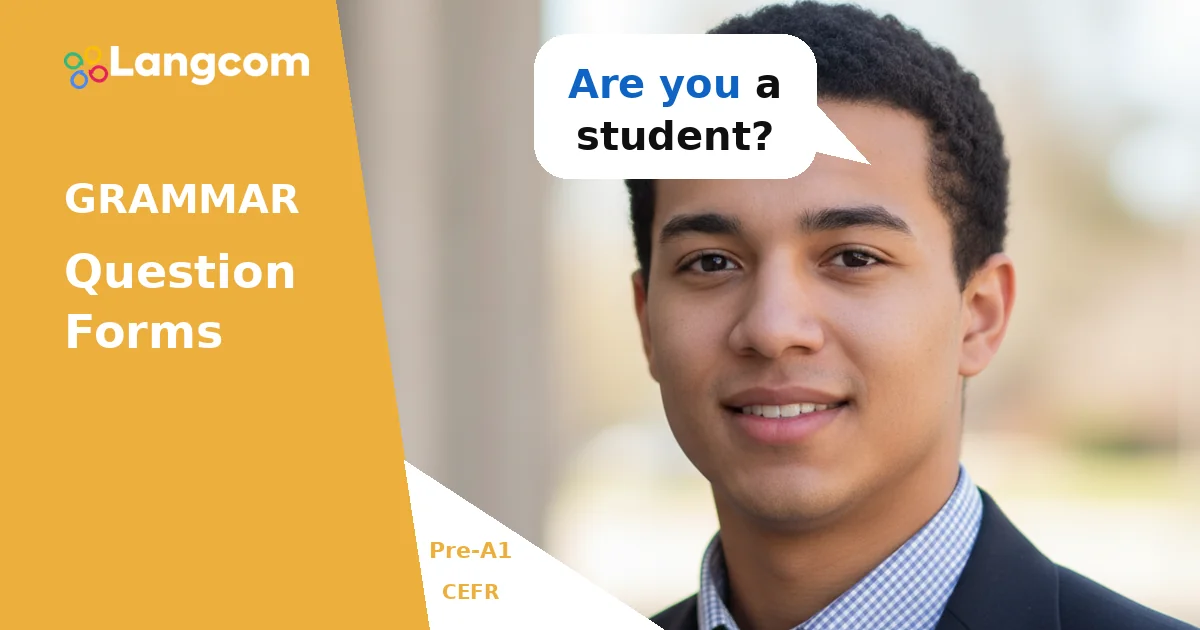

How Do We Make Questions in English?
In English, we often change the word order to make a question. We move the first verb or a special “helper” verb to the beginning of the sentence.
This is different from some languages where you only change your voice. In English, the word order is very important for questions.
- For statements: You are happy.
- For questions: Are you happy?
🎓 Apprenez l'anglais grâce à la méthode mixte
Petits groupes · Tuteur IA disponible 24 h/24, 7 j/7 · Préparation aux examens de Cambridge
Plans provenant de $39 $79 par mois
Questions with the Verb “Be” (Am, Is, Are)
The verb be is special. To ask a question, you simply put am, is, or are before the subject.
- Statement: She is a student.
- Question: Is she a student?
Short answers:
- Yes, I am. / No, I’m not.
- Yes, you are. / No, you aren’t.
- Yes, he is. / No, he isn’t.
Questions with “Have got” (Possession)
To ask about possession using have got, move have before the subject.
- Statement: They have got a car.
- Question: Have they got a car?
Short answers:
- Yes, I have. / No, I haven’t.
- Yes, she has. / No, she hasn’t.
Questions with “Can” (Ability)
Can is a modal verb. To make a question, put can before the subject.
- Statement: He can swim.
- Question: Can he swim?
Short answers:
- Yes, I can. / No, I can’t.
- Yes, they can. / No, they can’t.
Questions with “Do” and “Does” (Simple Present)
For most other verbs in the simple present, we use the auxiliary verb do ou does. Put do/does before the subject, and the main verb stays in its base form.
- Statement: You like pizza.
- Question: Do you like pizza?
- Statement: She works here.
- Question: Does she work here?
Short answers:
- Yes, I do. / No, I don’t.
- Yes, he does. / No, he doesn’t.
Questions with “There is” / “There are” (Existence)
To ask if something exists, we invert there et is/are.
- Statement: There is a book.
- Question: Is there a book?
- Statement: There are many people.
- Question: Are there many people?
Short answers:
- Yes, there is. / No, there isn’t.
- Yes, there are. / No, there aren’t.
| Question Type | Question Example | Positive Short Answer | Negative Short Answer |
|---|---|---|---|
| Be | Are you happy? | Yes, I am. | No, I’m not. |
| Have got | Have you got a cat? | Yes, I have. | No, I haven’t. |
| There is/are | Is there a mouse here? | Yes, there is. | No, there isn’t. |
| Can | Can you dance? | Yes, I can. | No, I can’t. |
| Do/Does | Do you like parties? | Yes, I do. | No, I don’t. |
Exemples
- Are you a student?
- Is he happy?
- Have you got a pen?
- Has she got a dog?
- Can you speak English?
- Can they help us?
- Do you live in Madrid?
- Does he play football?
- Is there a park nearby?
- Are there chairs in the room?
Entraînement
💬 Vous avez besoin de conseils personnalisés ?
En tant que centre de préparation agréé par Cambridge, nous pouvons vous aider à choisir la formation et la certification qui vous conviennent. Discutez-en dès aujourd'hui avec nos conseillers.
Discutez avec un conseiller sur WhatsAppErreurs courantes chez les hispanophones
Spanish speakers sometimes make these mistakes:
- Missing “Do” or “Does”: In Spanish, you can often just change your voice to ask a question. In English, you need do ou does for most verbs in the present simple.
- Wrong: You like coffee?
- Right: Do you like coffee?
- Incorrect Word Order: Remember to put the first verb or helper verb before the subject.
- Wrong: He is tall?
- Right: Is he tall?
- Incorrect “Have got” Question Form: When using have got for possession, remember to invert have and the subject.
- Wrong: You have got a pet?
- Right: Have you got a pet?
Questions fréquemment posées
What is a yes/no question?
A yes/no question is a question that you can answer with Yes ou No. For example, Are you hungry?
Why do we use “do” or “does”?
We use do ou does as “helper verbs” for most verbs in the simple present tense when we ask questions or make negative sentences. For example, Do you speak English?
How do I know if I need “is” or “are”?
Use is for singular subjects (one person/thing) and are for plural subjects (more than one person/thing) or with you. For example, Is he here? but Are they here?
Can I just say “Yes” or “No”?
Yes, you can. But in English, it is more polite and natural to use a short answer like Yes, I am ou No, I don’t.



0 commentaire