
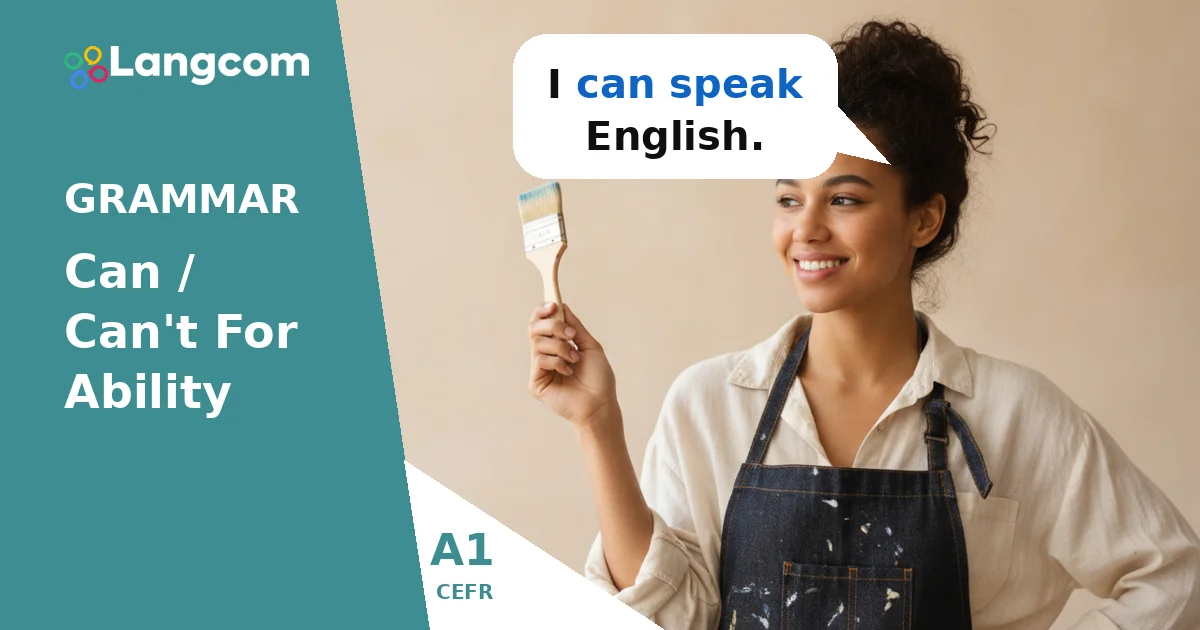

What Does ‘Can’ Mean in English?
Can is a modal verb. We use it to talk about ability. It means ‘poder’ in Spanish.
You use can to say that someone has the skill or the possibility to do something.
🎓 Englisch lernen mit der Blended-Methode
Kleingruppen · KI-Tutor rund um die Uhr · Vorbereitung auf die Cambridge-Prüfungen
Pläne von $39 $79 pro Monat
How to Use ‘Can’ for Positive Ability (+)
To say what someone can do, follow this simple structure:
- Subject + can + base form of the verb
The base form of the verb is the infinitive without ‘to’. For example, swim, nicht to swim.
How to Use ‘Can’t’ for Negative Ability (-)
To say what someone cannot do, or does not have the ability to do, use can’t.
Can’t is the short form of cannot. It is very common in spoken and written English.
- Subject + can’t + base form of the verb
Remember: ‘Can’ is Special!
Can is a modal verb, so it has special rules:
- It does not change for he, she, oder it. You do not add -s.
- You always use the base form of the next verb. Do not use to before the verb.
- You do not use do oder does with can for negatives. Just use can’t.
| Betreff | Positive (+) | Negative (-) |
|---|---|---|
| I | can speak | can’t speak |
| You | can speak | can’t speak |
| He/She/It | can speak | can’t speak |
| We | can speak | can’t speak |
| They | can speak | can’t speak |
Beispiele
- I can speak English.
- You can play the guitar.
- He can run fast.
- She can sing beautifully.
- It can fly.
- We can help you.
- They can understand Spanish.
- I can’t swim.
- You can’t see me.
- He can’t drive a car.
- She can’t lift heavy boxes.
- It can’t talk.
- We can’t go today.
- They can’t hear the music.
Übung
💬 Benötigen Sie eine individuelle Beratung?
Als autorisiertes Cambridge-Vorbereitungszentrum können wir Ihnen helfen, den richtigen Kurs und die passende Zertifizierung zu finden. Chatten Sie noch heute mit unseren Beratern.
Chatten Sie mit einem Berater auf WhatsAppHäufige Fehler bei Spanischsprechern
Spanish speakers sometimes make these mistakes with can:
- Adding ‘to’ after can:
❌ I can to swim.
✅ I can swim. - Adding ‘-s’ for he/she/it:
❌ She cans play tennis.
✅ She can play tennis. - Using don’t oder doesn’t for negatives:
❌ I don’t can speak French.
✅ I can’t speak French.
Häufig gestellte Fragen
What is the meaning of ‘can’?
Can means ‘poder’ in Spanish. We use it to express ability or possibility.
Does ‘can’ change for he/she/it?
No, can does not change. It is always can for all subjects (I, you, he, she, it, we, they).
What verb form comes after ‘can’ or ‘can’t’?
You always use the base form of the verb (the infinitive without ‘to’) after can oder can’t. For example, can run, nicht can to run.
What is the short form of ‘cannot’?
The short form of cannot is can’t. It is very common in everyday English.


0 Kommentare