
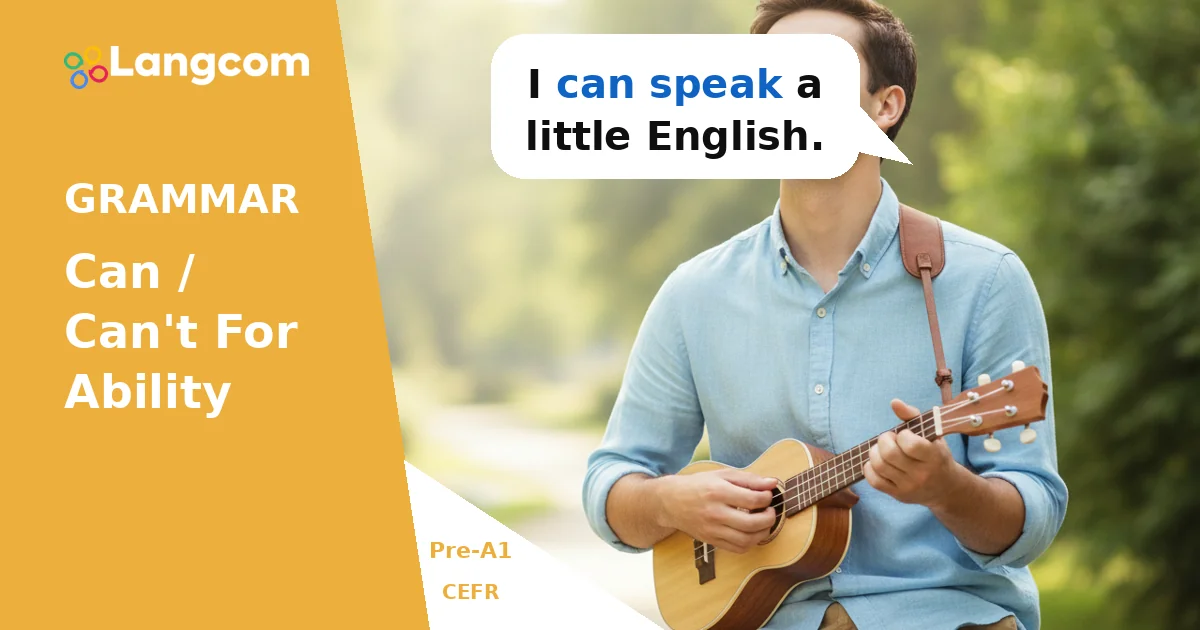

You use can to talk about abilities. This means things you know how to do or things that are possible for you. For example, if you know how to swim, you say I can swim. If you don’t know how to swim, you say I can’t swim. Can is a special verb called a modal verb. It always comes before another verb in its base form (without ‘to’). For questions, you put can at the beginning of the sentence. For example, Can you speak English? This simple word helps you express many things you do every day.
What does ‘Can’ mean in English?
Can is a very useful word in English. We use it to talk about abilities. An ability is something you know how to do.
- You use can with all subjects: I, you, he, she, it, we, they.
- After can, you always use the base form of the verb. This means the verb without to (e.g., swim, not to swim).
Look at these examples:
- I can speak English. (This is an ability.)
- She can play the guitar. (This is her ability.)
- We can run fast. (This is our ability.)
How do we use ‘Can’t’?
When you want to say you do not have an ability, you use can’t. Can’t is the short form of cannot.
- Can’t means you do not know how to do something.
- 喜欢 can, can’t also comes before the base form of the verb.
Here are some examples:
- I can’t swim. (I do not have this ability.)
- He can’t drive a car. (He does not know how.)
- They can’t sing very well. (They do not have good singing ability.)
How do we ask questions with ‘Can’?
To ask about someone’s ability, you put can at the beginning of the sentence.
- The structure is: Can + Subject + base verb?
Look at these questions and short answers:
- Can you cook?
- Yes, I can. (Affirmative short answer)
- No, I can’t. (Negative short answer)
More examples:
- Can she dance?
- Yes, she can.
- Can they speak French?
- No, they can’t.
| Question | Affirmative Answer | Negative Answer |
|---|---|---|
| Can you swim? | Yes, I can. | No, I can’t. |
| Can she dance? | Yes, she can. | No, she can’t. |
| Can they play football? | Yes, they can. | No, they can’t. |
示例
- I can speak a little English.
- My brother can play football very well.
- Birds can fly.
- I can’t draw.
- She can’t ride a bicycle.
- Can you help me?
- Can he understand Spanish? Yes, he can.
练习
西班牙语母语者常犯的错误
讲西班牙语的人有时会犯以下错误:
- Using ‘to’ after can:
I can to swim. (Incorrect)
I can swim. (Correct) - Putting ‘not’ in the wrong place:
I not can speak English. (Incorrect)
I can’t speak English. (Correct) - Changing can for ‘he’ or ‘she’:
She cans sing. (Incorrect)
She can sing. (Correct)
常见问题
What is ‘can’ used for?
Can is used to talk about ability, meaning something you know how to do or something that is possible.
What is the short form of ‘cannot’?
The short form of cannot 是 can’t.
Does ‘can’ change for ‘he’ or ‘she’?
No, can does not change. It is always can for all subjects (I, you, he, she, it, we, they).

0 条评论