

What Are Possessive Adjectives?
Possessive adjectives are special words that show ownership. They tell us that something belongs to someone or something.
Think of them like the words ‘mi’, ‘tu’, or ‘su’ in Spanish. They help you say whose car, whose dog, or whose house it is.
- They always come перед существительным.
- They describe the noun and show who it belongs to.
🎓 Изучайте английский по смешанной методике
Небольшие группы · ИИ-репетитор 24/7 · Подготовка к экзаменам Кембриджского университета
Планы от $39 $79 в месяц
The Possessive Adjectives in English
English has seven main possessive adjectives. Each one matches a subject pronoun:
- I становится my (e.g., my name)
- You становится your (e.g., your book)
- He становится his (e.g., his car)
- She становится her (e.g., her bag)
- It становится its (e.g., its tail)
- We становится our (e.g., our house)
- They становится their (e.g., their friends)
Remember, the possessive adjective always matches the owner, not the thing owned.
How to Use Possessive Adjectives Correctly
Using possessive adjectives is simple once you know the rules:
- Place them before the noun: Always put the possessive adjective directly before the noun it describes. For example, This is my phone.
- They don’t change for plural nouns: The possessive adjective stays the same, even if the noun is plural. For example, my car и my cars use the same possessive adjective.
- Match the owner: Choose the correct possessive adjective based on who owns the item. If a boy owns it, use his. If a girl owns it, use her.
| Subject Pronoun | Possessive Adjective |
|---|---|
| I | my |
| You | your |
| He | his |
| She | her |
| It | its |
| We | our |
| They | their |
Примеры
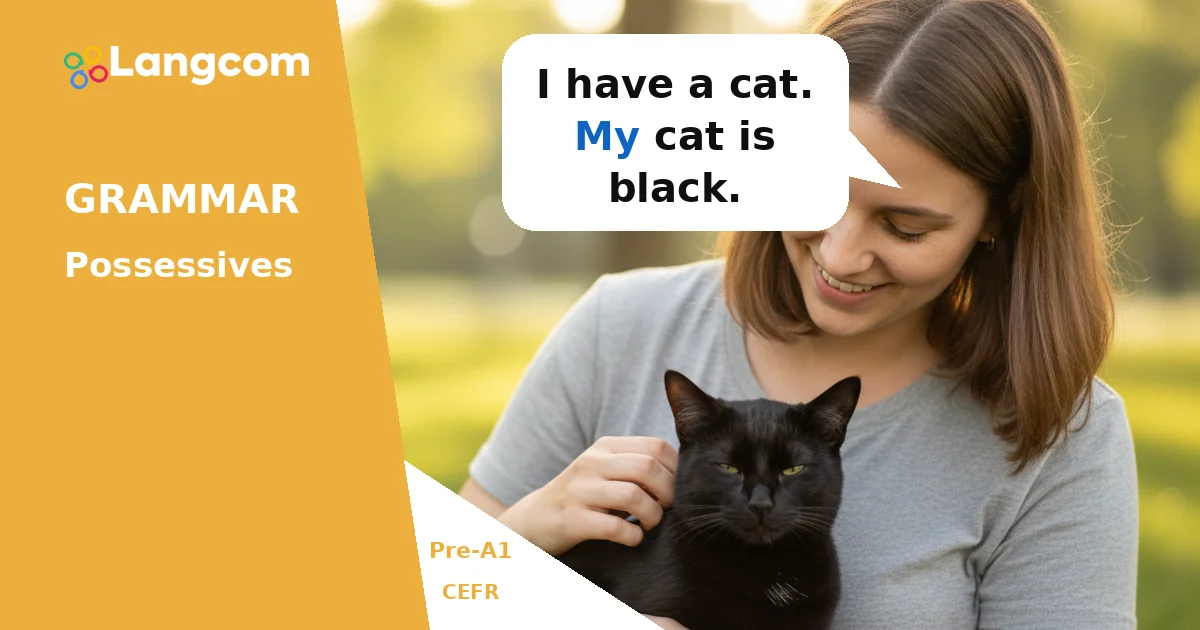
- I have a cat. My cat is black.
- You have a new bike. Your bike is red.
- He is Peter. His sister is a doctor.
- She is Maria. Her favorite color is blue.
- The dog likes its toy.
- We live in a big city. Our city is beautiful.
- They are students. Their teacher is kind.
Практика
💬 Нужна индивидуальная консультация?
Являясь официальным центром подготовки к экзаменам Кембриджского университета, мы поможем вам выбрать подходящий курс и программу сертификации. Свяжитесь с нашими консультантами уже сегодня.
Общайтесь с консультантом в WhatsAppРаспространенные ошибки у носителей испанского языка
Many Spanish speakers make a few common mistakes with possessive adjectives:
- Using ‘the’ instead of a possessive adjective: In Spanish, you might say ‘la casa’ even if it’s your house. In English, you must say my house.
Wrong: I like the car. (If it’s your car)
Right: I like my car. - Confusing his и her: In Spanish, ‘su’ can be for a boy or a girl. In English, you must choose based on the owner’s gender.
Wrong: She has his book. (If the book belongs to her)
Right: She has her book. - Confusing its и it’s: Its shows possession (e.g., The dog wagged its tail.). It’s is a contraction of it is или it has (e.g., It’s a sunny day.).
Wrong: The cat ate it’s food.
Right: The cat ate its food.
Часто задаваемые вопросы
What is a possessive adjective?
A possessive adjective is a word that shows who owns or possesses something. It comes before a noun. Examples are my, your, his, her, its, our, their.
Do possessive adjectives change for plural nouns?
No, possessive adjectives in English do not change their form if the noun they describe is singular or plural. For example, you say my book и my books.
What is the difference between his and her?
His is used when the owner is a male person (a boy or a man). Her is used when the owner is a female person (a girl or a woman).
Can I use ‘its’ for people?
No, you cannot use its for people. Its is only used for things or animals. For people, you use his или her.




0 Комментариев