

What Does Have Got Mean?
Have got is a common phrase in English. It means ‘to possess’ or ‘to own’ something.
You can use have got to talk about many things:
- Things you own: I’ve got a new bike.
- Family members or relationships: She’s got two brothers.
- Characteristics or appearance: He’s got blue eyes.
- Illnesses or problems: I’ve got a headache.
✍️ Not sure which level you are?
Take our free placement test and get personalized feedback from certified Cambridge examiners.
Faça nosso teste de nivelamento GRATUITOHow Do We Form Have Got?
Using have got is easy. We use have ou has, then got.
Positive Sentences:
Utilizamos have got for I, you, we, they. Nós usamos has got for he, she, it.
- I have got a book. (or I’ve got a book.)
- She has got a cat. (or She’s got a cat.)
Negative Sentences:
To make it negative, we add not between have/has e got. We usually use contractions.
- I have not got a pen. (or I haven’t got a pen.)
- He has not got a car. (or He hasn’t got a car.)
Questions:
To ask a question, we put have ou has at the beginning of the sentence.
- Have you got a brother?
- Has she got long hair?
Short Answers:
Utilizamos Yes, I have. ou No, I haven’t. (Do not use got in short answers).
- Yes, I have. / No, I haven’t.
- Yes, she has. / No, she hasn’t.
When Should You Use Have Got?
Have got is very common in spoken English and informal writing. It is a good choice for everyday conversations.
- Possession: When you own something. I’ve got a new phone.
- Characteristics: To describe how someone or something looks. My dog has got big ears.
- Relationships: To talk about family or friends. We’ve got a lot of friends.
- Illnesses: To say you are sick. He’s got a cold.
In more formal writing or situations, have (without got) is usually preferred. Both are correct, but have got sounds more natural in informal contexts.
| Subject | Positive Form | Negative Form | Question Form |
|---|---|---|---|
| I | I’ve got | I haven’t got | Have I got? |
| You | You’ve got | You haven’t got | Have you got? |
| He | He’s got | He hasn’t got | Has he got? |
| She | She’s got | She hasn’t got | Has she got? |
| It | It’s got | It hasn’t got | Has it got? |
| We | We’ve got | We haven’t got | Have we got? |
| They | They’ve got | They haven’t got | Have they got? |
Exemplos
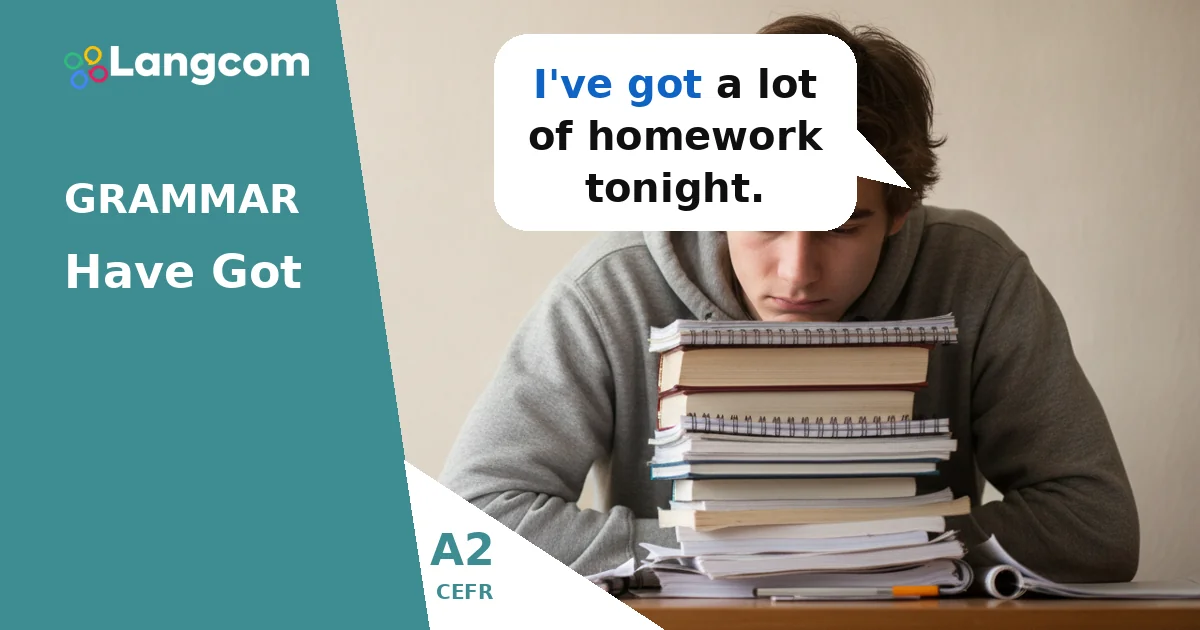
- I’ve got a lot of homework tonight.
- She hasn’t got any money.
- Have you got a favourite colour?
- My brother has got a new job.
- They’ve got a beautiful house in the countryside.
- It’s got a long tail.
- We haven’t got time for a break.
- Has he got a sister?
Prática
Ready to earn your certificate?
Langcom prepares students for Cambridge, IELTS, TOEFL, DELE, SIELE and Michigan exams.
Get started with LangcomErros comuns entre falantes de espanhol
Spanish speakers sometimes make mistakes with have got because of how ‘tener’ works in Spanish.
- Using do/does with have got: This is a common error. You should NOT use do ou does with have got.
- Incorreto: Do you have got a pet?
- Correto: Have you got a pet? OU Do you have a pet?
- Using have got for actions: Have got is only for possession, relationships, or characteristics. It is NOT for actions.
- Incorreto: I’ve got breakfast at 8 AM. (Meaning ‘I eat breakfast’)
- Correto: I have breakfast at 8 AM.
- Correto: I’ve got breakfast ready. (Meaning ‘I possess ready breakfast’)
- Incorrect contractions: Remember the correct contractions: I’ve got, he’s got, haven’t got, hasn’t got. Do not say I am got ou he is got.
Perguntas frequentes
What is the difference between have e have got?
When talking about possession, relationships, or characteristics, have e have got mean the same thing. For example, I have a car e I’ve got a car are both correct. Have got is more common in informal, spoken English, while have is used in both formal and informal contexts.
Can I use have got in formal English?
Generally, have got is considered informal. In formal writing or speaking, it is usually better to use have without got. For example, in an academic essay, you would write The company has many employees, not The company has got many employees.
Is have got used in American English?
Yes, have got is used in American English, but it is often shortened to got in very informal speech, like I got a new phone (meaning I’ve got a new phone). However, for A2 learners, it’s best to learn the full have got form first, as it is standard in British English and understood everywhere.
How is have got tested in the A2 Key exam?
In the A2 Key (KET) exam, you might see have got in reading tasks, or you might need to use it correctly in writing tasks, such as completing sentences or writing short messages. For example, you might need to choose between have got e has got based on the subject, or form a correct question using have/has got.


0 Comentários