

For example, you use be to describe yourself or others, as in I am happy. Have got shows possession, like She has got a book. Can expresses ability, for instance He can swim. To talk about things that exist, you use there is または there are, 、つまり There is a park. Finally, the simple present helps you talk about habits and likes, such as I like coffee. Mastering these basic verbs will help you communicate clearly and confidently in English.
What are the most important verbs for beginners?
At the Pre-A1 level, some verbs are super important. They help you make basic sentences and talk about many things. These verbs are like the foundation of English.
We will look at five key verb types:
- The verb to be (am, is, are)
- The verb have got (have got, has got)
- The modal verb can
- The expressions there is そして there are
- について simple present for other verbs
How do I use the verb to be?
We use the verb to be to talk about:
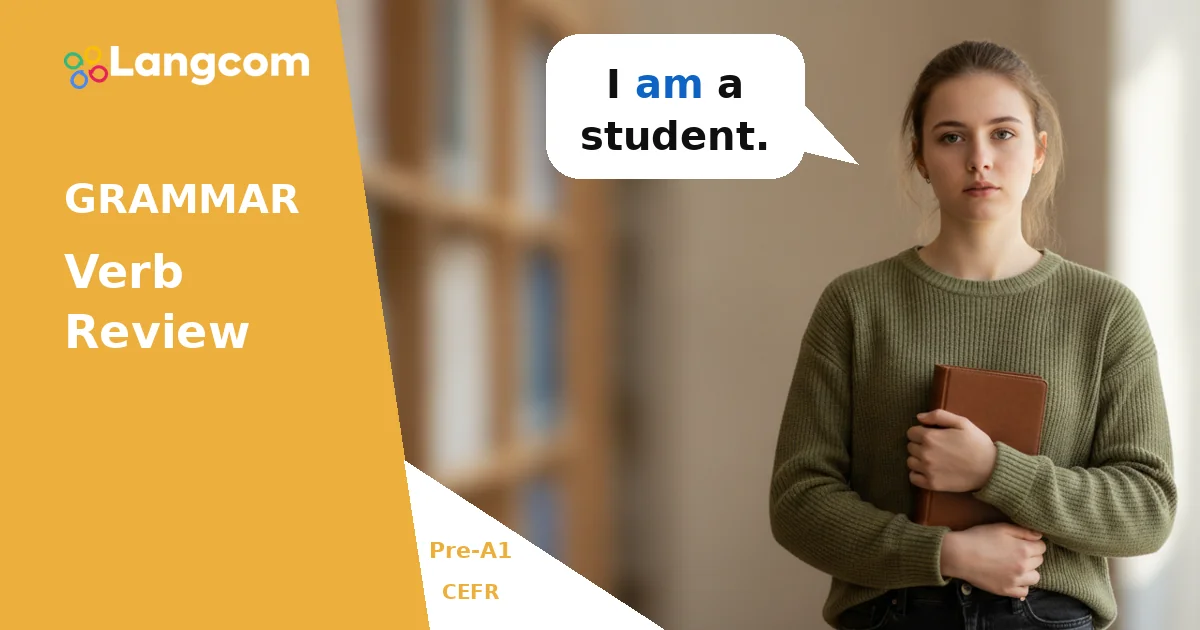
- Identity: I am a student.
- Description: She is happy.
- 場所は? They are at home.
The forms of to be change with the subject:
- I am
- You are
- He/She/It is
- We are
- They are
For negative sentences, we add not. Often, we use contractions:
- I am not
- You aren’t (または You are not)
- He/She/It isn’t (または He/She/It is not)
- We aren’t (または We are not)
- They aren’t (または They are not)
When do I use have got?
当社では have got to talk about possession. This means something belongs to someone. It is very common in spoken English.
The forms of have got change with the subject:
- I have got
- You have got
- He/She/It has got
- We have got
- They have got
For negative sentences, we add not between have/has そして got. We often use contractions:
- I haven’t got (または I have not got)
- You haven’t got (または You have not got)
- He/She/It hasn’t got (または He/She/It has not got)
- We haven’t got (または We have not got)
- They haven’t got (または They have not got)
How do I talk about ability with can?
当社では can to talk about ability. This means what someone is able to do. After can, we always use the base form of another verb.
Can is special because it does not change for different subjects:
- I can swim.
- You can speak English.
- He/She/It can fly.
- We can play football.
- They can sing.
For negative sentences, we add not after can. The contraction is can’t:
- I can’t swim. (または I cannot swim.)
- You can’t speak French.
- He/She/It can’t fly.
How do I say something exists with there is / there are?
当社では there is そして there are to say that something exists in a place. We use there is for one thing (singular) and there are for many things (plural).
- Singular: There is a book on the table.
- Plural: There are two chairs in the room.
For negative sentences, we add not after is または are. We often use contractions:
- Singular negative: There isn’t a pen here. (または There is not a pen here.)
- Plural negative: There aren’t any students in the class. (または There are not any students in the class.)
What is the simple present for other verbs?
We use the simple present for habits, routines, and things that are generally true. It also expresses likes and dislikes.
For most subjects (I, You, We, They), the verb form is the base form:
- I like pizza.
- You play tennis.
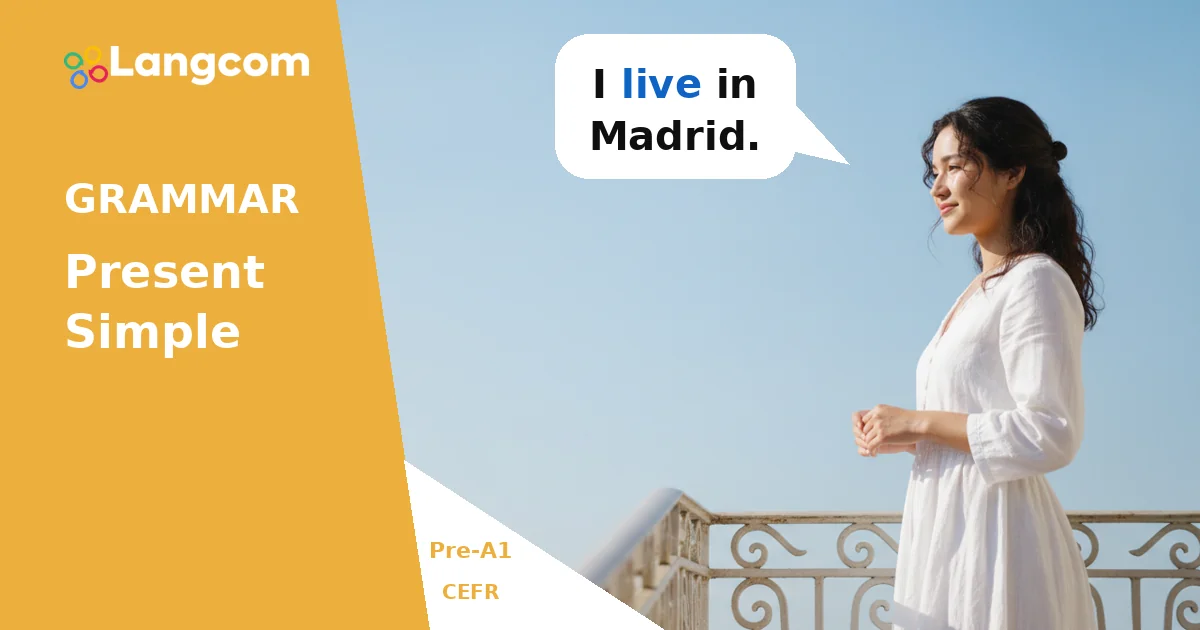
- We live in Madrid.
For He, She, It, we add -s または -es to the verb:
- He likes coffee.
- She plays football.
- It rains a lot in winter.
For negative sentences, we use don’t (for I, You, We, They) or doesn’t (for He, She, It) before the base form of the verb:
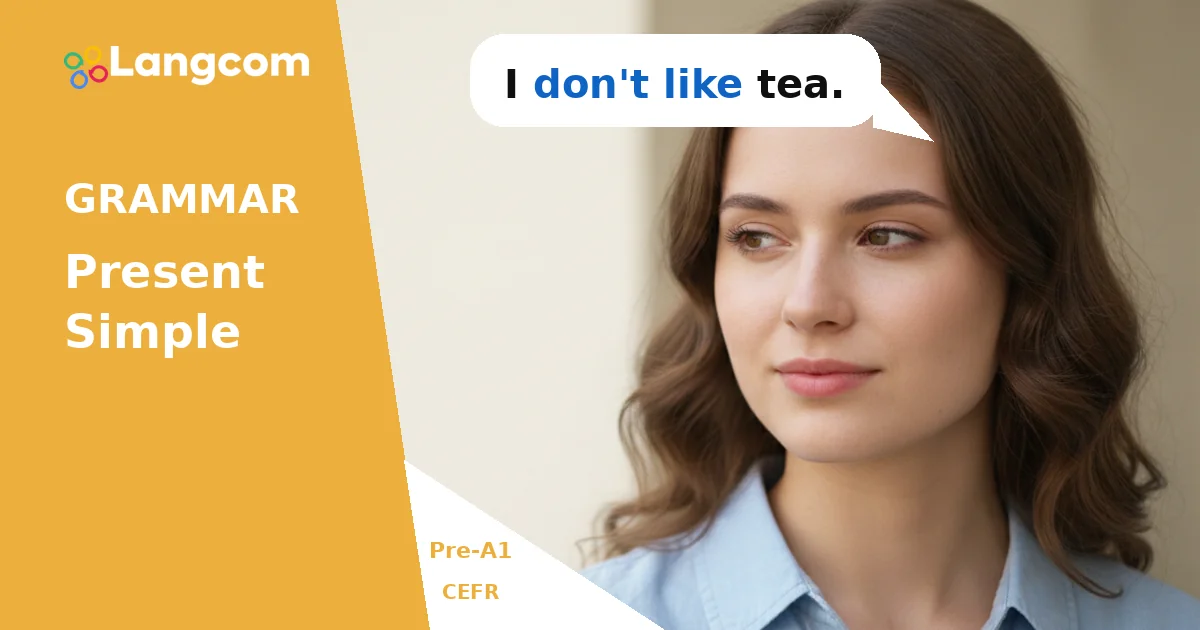
- I don’t like tea.
- She doesn’t work on Sundays.
| Verb Type | Affirmative Example | Negative Example |
|---|---|---|
| To Be | I am happy. | I am not happy. |
| She is a student. | She isn’t a student. | |
| They are friends. | They aren’t friends. | |
| Have Got | I have got a book. | I haven’t got a book. |
| He has got a car. | He hasn’t got a car. | |
| Can | I can swim. | I can’t swim. |
| She can sing. | She can’t sing. | |
| There Is / There Are | There is a park. | There isn’t a park. |
| There are trees. | There aren’t trees. | |
| Simple Present | I like coffee. | I don’t like coffee. |
| He works here. | He doesn’t work here. |
例
- I am a student.
- She is happy.
- They are at home.
- It isn’t cold today.
- I have got a new book.
- He has got a blue car.
- We haven’t got much time.
- I can speak a little English.
- Birds can fly.
- You can’t park here.
- There is a cat on the chair.
- There are two apples in the basket.
- There isn’t a supermarket near here.
- I like pizza.
- She likes coffee.
- We don’t watch TV often.
- He doesn’t play football.
練習
💬 個別のアドバイスが必要ですか?
当校はケンブリッジ試験の公認準備センターとして、皆様に最適なコースや資格取得への道をご案内いたします。ぜひ今すぐアドバイザーにご相談ください。.
WhatsAppでアドバイザーとチャットスペイン語話者がよく犯す間違い
Spanish speakers sometimes make these common mistakes:
- Using to have for age or feelings: In Spanish, you say ‘Tengo 20 años’ (I have 20 years). In English, we use to be: I am 20 years old. (NOT I have 20 years old.) Similarly, for hunger or thirst, it’s I am hungry, not I have hungry.
- ~を忘れて -s ~のために he/she/it in the simple present: Remember, for he, she, it, the verb usually ends in -s. For example, She likes (NOT She like).
- Using not directly with other verbs: For most verbs in the simple present, you need don’t または doesn’t for negatives. For example, I don’t speak Spanish (NOT I not speak Spanish).
よくある質問
What is the difference between is and are?
Is is for singular subjects (one person or thing), like He is または The book is. Are is for plural subjects (two or more people or things), like They are または The students are.
Can I use have instead of have got for possession?
Yes, you can use have for possession, especially in American English or more formal contexts. However, for beginners, have got is very common and natural in British English. Both I have a car そして I have got a car are correct.
How do I make questions with these verbs?
For to be そして can, you swap the subject and the verb: Are you happy? または Can you swim? For have got, you swap have/has with the subject: Have you got a pet? For the simple present (other verbs), you use Do または Does at the beginning: Do you like coffee? または Does she speak English?
Why is the -s important in the simple present?
について -s at the end of the verb for he, she, it (third person singular) is a grammatical rule in English. It helps show who is doing the action. Forgetting it is a common mistake for learners, but it’s important for correct English.

コメント 0 件