

What Are High Numbers in English?
High numbers are numbers bigger than 100. They help us talk about large amounts of things.
For example, we use them for:
- Money: £500 (five hundred pounds)
- People: 1,000 people (one thousand people)
- Distances: 1,000,000 miles (one million miles)
🎓 Impara l'inglese con il metodo misto
Piccoli gruppi · Tutor IA disponibile 24 ore su 24, 7 giorni su 7 · Preparazione agli esami di Cambridge
Piani da $39 $79 al mese
How Do We Say Numbers in the Hundreds?
To say numbers from 101 to 999, we use the word hundred.
- Start with the number of hundreds.
- Then add hundred.
- After hundred, we often use and before the last two digits (especially in British English).
Examples:
- 100: one hundred
- 250: two hundred and fifty
- 705: seven hundred and five
- 999: nine hundred and ninety-nine
How Do We Say Numbers in the Thousands?
For numbers from 1,000 to 999,999, we use the word thousand.
- Start with the number of thousands.
- Then add thousand.
- After thousand, you can add hundred and other numbers, using and if needed.
Examples:
- 1,000: one thousand
- 5,000: five thousand
- 10,000: ten thousand
- 25,400: twenty-five thousand, four hundred
- 123,456: one hundred and twenty-three thousand, four hundred and fifty-six
How Do We Say Millions and Billions?
For even bigger numbers, we use million e billion.
- 1,000,000 is one million.
- 1,000,000,000 is one billion. (Be careful! This is different from Spanish “billón”.)
Esempio:
- 3,000,000: three million
- 5,200,000: five million, two hundred thousand
Important Rules for Big Numbers
Remember these two important rules when saying high numbers:
- No -s for plural: When you use a number before hundred, thousand, million, oppure billion, these words stay singular.
- Correct: two hundred
- Incorrect: two hundreds
- Use and: In British English, we use and after hundred (and sometimes thousand) before the tens and units.
- Correct: one hundred and fifty
- Correct: one thousand, two hundred and thirty-four
Esempi
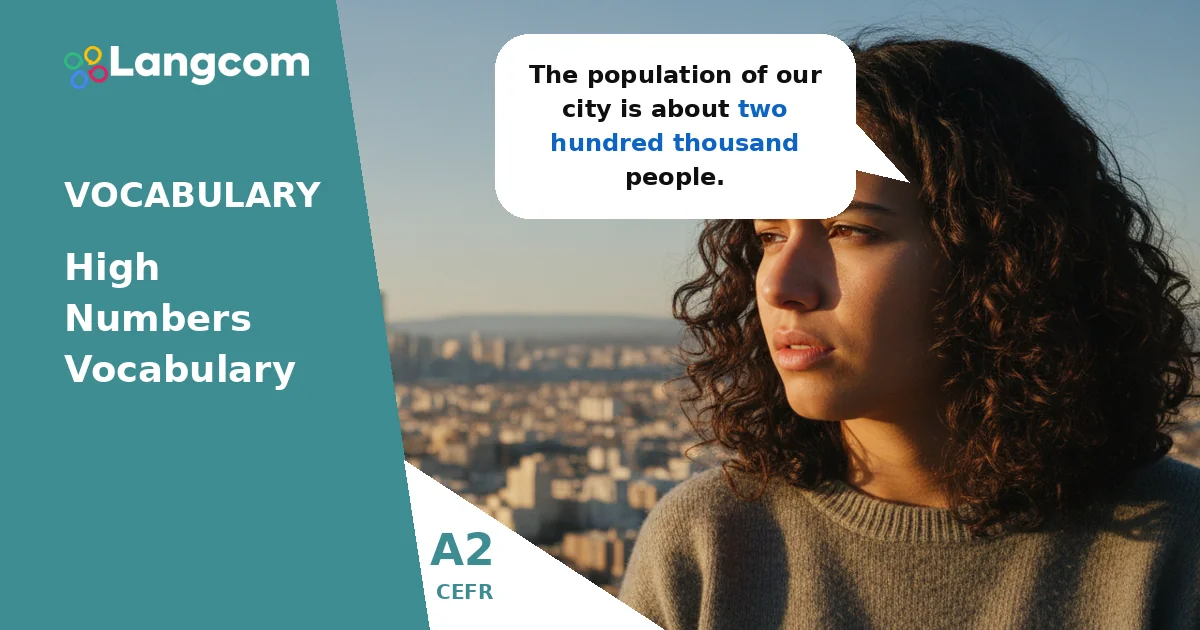
- The population of our city is about two hundred thousand people.
- I need to save five hundred and fifty euros for my trip.
- The company made one million dollars last year.
- The book has three hundred and twelve pages.
- There are one thousand, four hundred and forty minutes in a day.
Esercitazione
💬 Hai bisogno di una consulenza personalizzata?
In qualità di Centro autorizzato di preparazione agli esami Cambridge, possiamo aiutarti a scegliere il corso e la certificazione più adatti alle tue esigenze. Contatta oggi stesso i nostri consulenti.
Chatta con un consulente su WhatsAppErrori comuni per chi parla spagnolo
Spanish speakers often make a few common mistakes with high numbers in English.
- Adding -s: In Spanish, you might say “doscientos” (two hundreds). But in English, hundred, thousand, million, e billion do not take an -s when a number comes before them.
- Wrong: five thousands
- Right: five thousand
- La parola billion: This is a very important difference! In Spanish, “un billón” means one trillion (1,000,000,000,000) in English. In English, one billion means one thousand million (1,000,000,000).
- Spanish: un billón = English: one trillion
- Spanish: mil millones = English: one billion
- Missing and: Sometimes learners forget to add and after hundred, especially in British English.
- Wrong: two hundred fifty
- Right: two hundred and fifty
Domande frequenti
What is the difference between million and billion?
One million is 1,000,000 (a one with six zeros). One billion is 1,000,000,000 (a one with nine zeros). Remember that Spanish “billón” is much larger than English billion.
Do I always use ‘and’ when saying numbers?
In British English, it is common and correct to use and after hundred (e.g., one hundred and twenty). In American English, and is often omitted (e.g., one hundred twenty), but it is not wrong to use it.
Is it ‘two hundreds’ or ‘two hundred’?
It is always two hundred. The words hundred, thousand, million, e billion do not take an -s when they are preceded by a number.
How do I write large numbers in English?
We use commas (,) to separate groups of three digits from the right. For example, 1,000 (one thousand), 10,000 (ten thousand), 1,000,000 (one million).




0 Commenti