
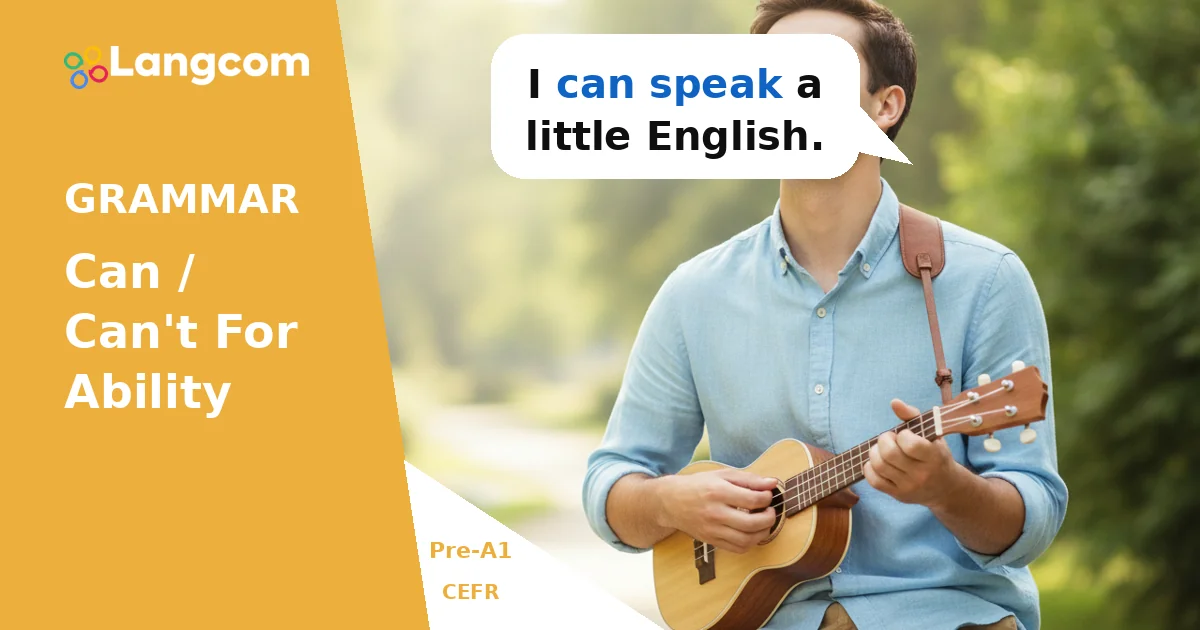

What does ‘Can’ mean in English?
Can is a very useful word in English. We use it to talk about abilities. An ability is something you know how to do.
- You use can with all subjects: I, you, he, she, it, we, they.
- After can, you always use the base form of the verb. This means the verb without to (e.g., swim, not to swim).
Look at these examples:
- I can speak English. (This is an ability.)
- She can play the guitar. (This is her ability.)
- We can run fast. (This is our ability.)
🎓 Impara l'inglese con il metodo misto
Piccoli gruppi · Tutor IA disponibile 24 ore su 24, 7 giorni su 7 · Preparazione agli esami di Cambridge
Piani da $39 $79 al mese
How do we use ‘Can’t’?
When you want to say you do not have an ability, you use can’t. Can’t is the short form of cannot.
- Can’t means you do not know how to do something.
- Come can, can’t also comes before the base form of the verb.
Here are some examples:
- I can’t swim. (I do not have this ability.)
- He can’t drive a car. (He does not know how.)
- They can’t sing very well. (They do not have good singing ability.)
How do we ask questions with ‘Can’?
To ask about someone’s ability, you put can at the beginning of the sentence.
- The structure is: Can + Subject + base verb?
Look at these questions and short answers:
- Can you cook?
- Yes, I can. (Affirmative short answer)
- No, I can’t. (Negative short answer)
More examples:
- Can she dance?
- Yes, she can.
- Can they speak French?
- No, they can’t.
| Question | Affirmative Answer | Negative Answer |
|---|---|---|
| Can you swim? | Yes, I can. | No, I can’t. |
| Can she dance? | Yes, she can. | No, she can’t. |
| Can they play football? | Yes, they can. | No, they can’t. |
Esempi
- I can speak a little English.
- My brother can play football very well.
- Birds can fly.
- I can’t draw.
- She can’t ride a bicycle.
- Can you help me?
- Can he understand Spanish? Yes, he can.
Esercitazione
💬 Hai bisogno di una consulenza personalizzata?
In qualità di Centro autorizzato di preparazione agli esami Cambridge, possiamo aiutarti a scegliere il corso e la certificazione più adatti alle tue esigenze. Contatta oggi stesso i nostri consulenti.
Chatta con un consulente su WhatsAppErrori comuni per chi parla spagnolo
Chi parla spagnolo a volte commette questi errori:
- Using ‘to’ after can:
I can to swim. (Incorrect)
I can swim. (Correct) - Putting ‘not’ in the wrong place:
I not can speak English. (Incorrect)
I can’t speak English. (Correct) - Changing can for ‘he’ or ‘she’:
She cans sing. (Incorrect)
She can sing. (Correct)
Domande frequenti
What is ‘can’ used for?
Can is used to talk about ability, meaning something you know how to do or something that is possible.
What is the short form of ‘cannot’?
The short form of cannot is can’t.
Does ‘can’ change for ‘he’ or ‘she’?
No, can does not change. It is always can for all subjects (I, you, he, she, it, we, they).

0 Commenti