

Why Does the Letter ‘A’ Have Different Sounds?
English pronunciation can be tricky because spelling does not always match sound. Many letters, especially vowels, can make different sounds.
The letter ‘a’ is a perfect example. Its sound changes depending on the letters around it and if the syllable is stressed or unstressed.
🎓 Englisch lernen mit der Blended-Methode
Kleingruppen · KI-Tutor rund um die Uhr · Vorbereitung auf die Cambridge-Prüfungen
Pläne von $39 $79 pro Monat
Sound 1: The Short ‘A’ (/æ/)
This sound is common in English. To make it, open your mouth wide, like you are going to say ‘ah’, but then flatten your tongue. It is a short, sharp sound.
- Think of the ‘a’ in cat oder apple.
- Examples from your lesson: thanks, back, black.
Sound 2: The ‘AW’ Sound (/ɔː/)
This sound is longer and more rounded. Your lips should be slightly rounded, like when you say ‘oh’, but with a deeper sound.
- It often appears before ‘ll’ or ‘lk’.
- Think of the ‘a’ in ball oder water.
- Examples from your lesson: call, talk, tall, small.
Sound 3: The Short ‘I’ Sound (/ɪ/)
Sometimes, an ‘a’ can sound like a short ‘i’. This often happens in unstressed syllables in longer words.
- Your mouth is relaxed, and the sound is quick, similar to the ‘i’ in sit.
- Examples from your lesson: message, village, luggage.
Sound 4: The Long ‘A’ Sound (/eɪ/)
This is a diphthong, meaning it’s two sounds blended together. It starts like ‘e’ and ends like ‘i’.
- It’s the sound you hear in name oder day.
- Common spellings include ‘a_e’ (magic ‘e’), ‘ai’, and ‘ay’.
- Examples from your lesson: later, wait, voicemail, same, table.
How Can I Practice These Sounds?
Listen carefully to native speakers. Pay attention to how they pronounce the letter ‘a’ in different words. You can also:
- Repeat words: Say the example words aloud many times.
- Record yourself: Use your phone to record your voice and compare it to a native speaker.
- Use a dictionary: Look up words and check the phonetic transcription (IPA symbols) to see the correct sound.
| Sound | IPA Symbol | Beispiele |
|---|---|---|
| Short ‘A’ | /æ/ | thanks, back, black |
| ‘AW’ Sound | /ɔː/ | call, talk, tall, small |
| Short ‘I’ Sound | /ɪ/ | message, village, luggage |
| Long ‘A’ | /eɪ/ | later, wait, voicemail, same, table |
Beispiele
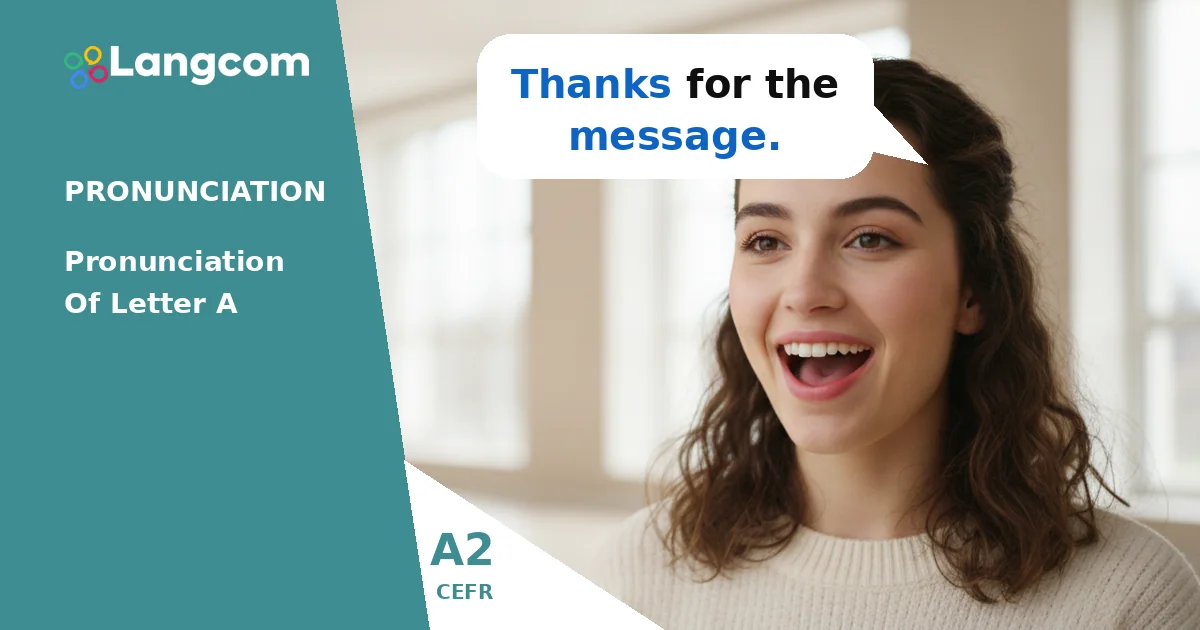
- Thanks for the message.
- Can you call me later?
- I need to wait for the small black cat.
- This village has a tall table.
- Did you get my voicemail?
Übung
💬 Benötigen Sie eine individuelle Beratung?
Als autorisiertes Cambridge-Vorbereitungszentrum können wir Ihnen helfen, den richtigen Kurs und die passende Zertifizierung zu finden. Chatten Sie noch heute mit unseren Beratern.
Chatten Sie mit einem Berater auf WhatsAppHäufige Fehler bei Spanischsprechern
Common Mistakes for Spanish Speakers
Many Spanish speakers tend to pronounce all ‘a’s with the single ‘a’ sound from Spanish, like in casa. This can lead to misunderstandings.
- Mistake: Pronouncing cat with a Spanish ‘a’ sound, making it sound like cot (with a Spanish ‘a’).
- Correct: The ‘a’ in cat is the short /æ/ sound.
- Mistake: Saying call with a short Spanish ‘a’ instead of the rounded /ɔː/ sound.
- Correct: The ‘a’ in call is a long ‘aw’ sound.
Remember that English ‘a’ is not always the same. Practice the different sounds to avoid confusion and speak more clearly.
Häufig gestellte Fragen
Why is English pronunciation so difficult for learners?
English spelling is not always phonetic. This means letters often have different sounds depending on the word. For example, the letter ‘a’ can make four common sounds, as you learned in this lesson. This is different from many other languages where letters usually have one sound.
Are there rules for when ‘a’ makes each sound?
Yes, there are some common patterns, but also many exceptions! For example, ‘a’ followed by a single consonant often makes the /æ/ sound (cat). ‘A’ followed by ‘ll’ or ‘lk’ often makes the /ɔː/ sound (call). The ‘a_e’ pattern often makes the /eɪ/ sound (name). However, it’s best to learn words by listening and practicing.
What is the most common sound for the letter ‘a’?
The short ‘a’ (/æ/) and the long ‘a’ (/eɪ/) are both very common. However, the exact frequency can vary. It’s important to recognize all four main sounds to improve your A2 pronunciation.
How can I improve my listening for these ‘a’ sounds?
Listen to English songs, podcasts, and movies. Try to identify the different ‘a’ sounds in words. You can also use online dictionaries that provide audio pronunciations. The more you listen, the better your ear will become at distinguishing these sounds.

0 Kommentare