

What Are Noun Clauses with Question Words?
Noun clauses are groups of words that function as a noun. They can be the subject of a verb, the object of a verb, the object of a preposition, or a complement.
When these clauses start with a question word, they introduce an indirect question or statement. They do not ask a direct question.
- I wonder what time it is. (Object of the verb wonder)
- How they solved the problem is a mystery. (Subject of the verb is)
✍️ Du bist dir nicht sicher, auf welchem Niveau du bist?
Machen Sie unseren kostenlosen Einstufungstest und erhalten Sie individuelles Feedback von zertifizierten Cambridge-Prüfern.
Machen Sie unseren KOSTENLOSEN EinstufungstestHow Do Noun Clauses with Question Words Work?
The key to forming these clauses correctly is to remember the word order. Unlike direct questions, noun clauses use statement word order.
- Question Word + Subject + Verb: This is the standard structure.
- There is no inversion of the subject and verb.
- You do not use a question mark at the end of the sentence, unless the main clause is a question.
Consider this example:
- Direct question: Where is the nearest exit?
- Noun clause: Could you tell me where the nearest exit is?
Which Question Words Can You Use?
You can use most common question words to introduce noun clauses. Each word helps to introduce a specific type of information.
- What: Refers to a thing or idea. I don’t understand what you mean.
- Who/Whom: Refers to a person. She asked who was coming to the party. (Whom is more formal).
- Where: Refers to a place. He knows where they hid the treasure.
- When: Refers to a time. Let’s decide when we should meet.
- Why: Refers to a reason. Can you explain why you were late?
- How: Refers to a manner or method. They showed us how to use the new software.
- Which: Used when there is a choice from a limited number. Tell me which book you prefer.
Using ‘Whether’ or ‘If’ for Yes/No Questions
When the original direct question is a yes/no question (without a question word), you use whether oder if to introduce the noun clause.
- Whether is generally more formal and can be used with or not.
- If is more common in everyday speech.
Examples:
- Direct question: Is she coming?
- Noun clause: I wonder if she is coming. ODER I wonder whether she is coming.
- Noun clause with or not: Let me know whether or not you can attend.
Noun Clauses vs. Relative Clauses: What’s the Difference?
At C1 level, it is important to distinguish between noun clauses and relative clauses, as both can start with similar words.
- Noun clauses act as nouns. They are essential parts of the sentence structure (subject, object, complement).
- Relative clauses (also called adjective clauses) describe or give more information about a noun or pronoun that comes before them. They function like adjectives.
Compare these sentences:
- Noun clause: I know what he said. (What he said is the object of know.)
- Relative clause: I read the book that he recommended. (That he recommended describes the book.)
| Direct Question | Noun Clause (Indirect Question) |
|---|---|
| Where is the report? | Do you know where the report is? |
| When will they arrive? | I wonder when they will arrive. |
| What did he say? | Tell me what he said. |
| Is she ready? | I need to know if she is ready. |
| How can we improve? | Let’s discuss how we can improve. |
Beispiele
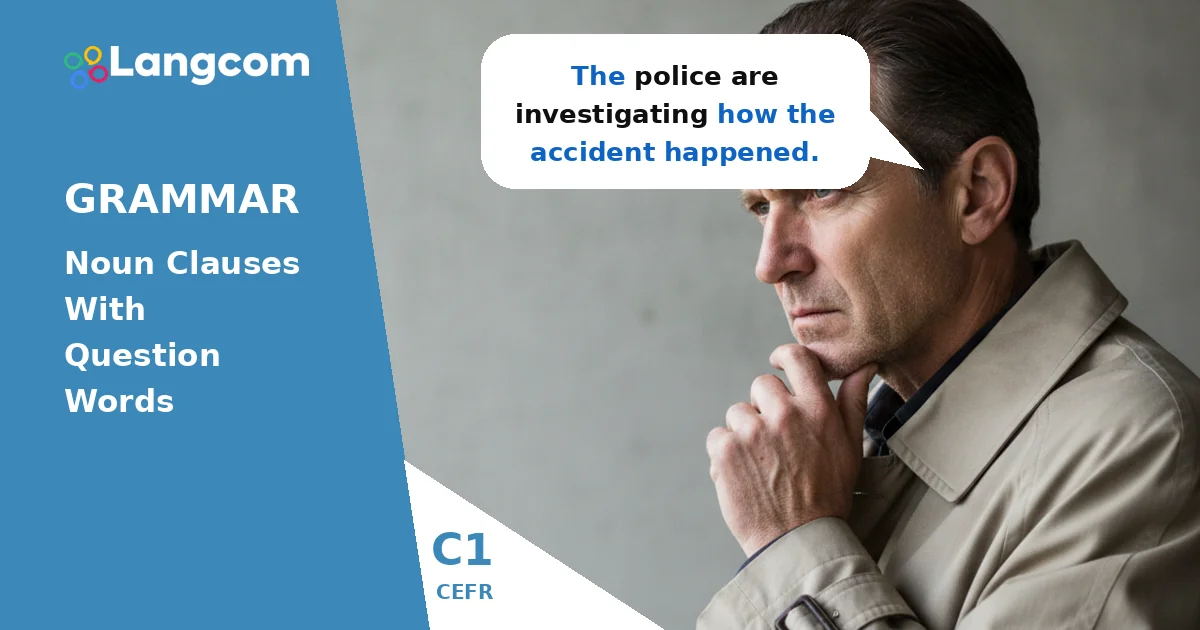
- The police are investigating how the accident happened.
- What you decide to do next is entirely up to you.
- Could you tell me who is responsible for this project?
- They haven’t announced when the new policy will take effect.
- I’m not sure whether we should proceed with the plan.
- It’s important to understand why these changes are necessary.
- She explained which option would be best for our situation.
Übung
Bist du bereit, dein Zertifikat zu erwerben?
Der Kurs Langcom bereitet die Teilnehmer auf die Prüfungen von Cambridge, IELTS, TOEFL, DELE, SIELE und Michigan vor.
Erste Schritte mit LangcomHäufige Fehler bei Spanischsprechern
Spanish speakers often make two main mistakes with noun clauses: word order and confusing them with relative clauses.
1. Incorrect Word Order (Inversion)
A common error is to use question word order (inversion of subject and verb) inside the noun clause, similar to direct questions in Spanish.
- Falsch: Do you know where is the museum?
- Richtig: Do you know where the museum is? (Subject the museum comes before verb is)
2. Confusing with Relative Clauses
Sometimes, learners confuse noun clauses with relative clauses, especially with words like what und that.
- Falsch: I don’t know the thing that he wants. (While grammatically possible, it’s less natural and often a sign of over-complication.)
- Richtig: I don’t know what he wants. (What he wants acts as the object.)
Häufig gestellte Fragen
What is the main rule for word order in noun clauses with question words?
The main rule is to use statement word order: the question word is followed by the subject, then the verb. For example, I asked what time it was, nicht what time was it.
Can a noun clause with a question word be the subject of a sentence?
Yes, absolutely. For example, in the sentence How they managed to escape is still a mystery, the entire clause How they managed to escape functions as the subject of the verb is.
When should I use ‘whether’ instead of ‘if’ in a noun clause?
Whether is often preferred in more formal contexts, before an infinitive (whether to go), or when followed by or not. If is more common in everyday speech and less formal situations, especially when the meaning is ‘in case that’.
How can I avoid confusing noun clauses with relative clauses?
Remember that a noun clause acts as a noun (subject, object, complement) and often replaces a noun phrase. A relative clause, however, describes a noun that is already present in the sentence. For example, I heard what she said (noun clause) vs. I heard the story that she told (relative clause describing ‘story’).


0 Kommentare