
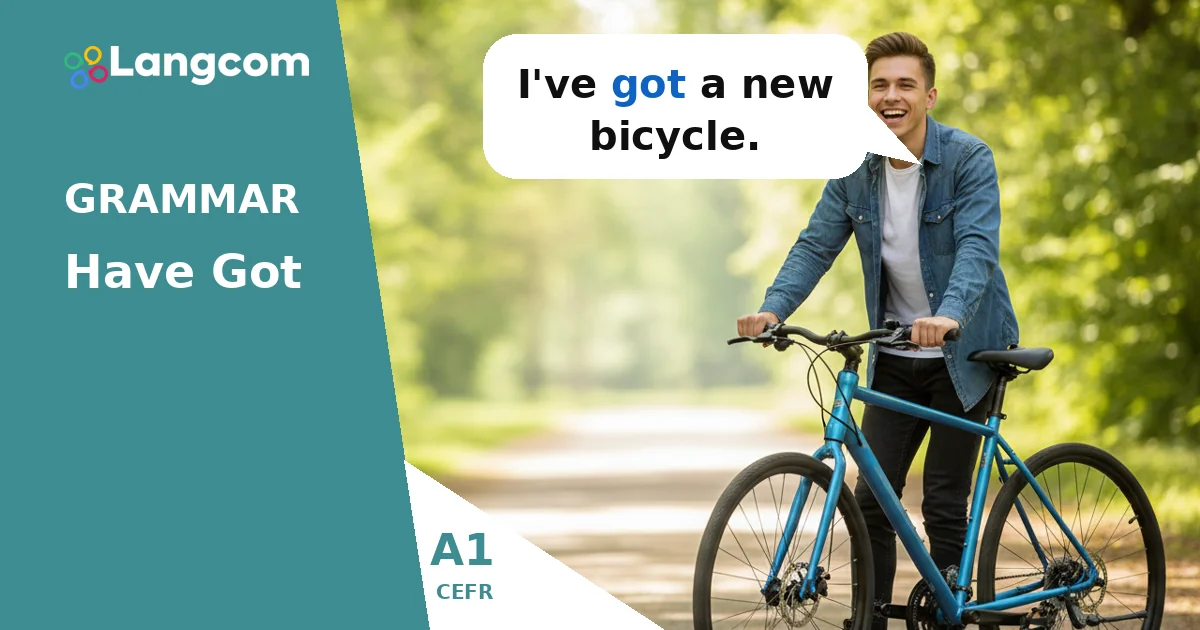

What Does Have Got Mean?
Have got is a phrase we use to talk about:
- Possession: Things you own. For example, I’ve got a car.
- Family: Your relatives. For example, She’s got two brothers.
- Descriptions: How people or things look. For example, He’s got blue eyes.
- Illnesses: When you feel sick. For example, I’ve got a cold.
It has a similar meaning to the verb have when talking about these topics. However, have got is often more informal and common in spoken English, especially in British English.
🎓 Изучайте английский по смешанной методике
Небольшие группы · ИИ-репетитор 24/7 · Подготовка к экзаменам Кембриджского университета
Планы от $39 $79 в месяц
How Do We Form Sentences with Have Got?
The structure for have got is simple. We use have или has, plus got.
Positive Sentences
Мы используем have got для I, you, we, they. We use has got для he, she, it.
- I have got (или I’ve got)
- You have got (или You’ve got)
- He has got (или He’s got)
- She has got (или She’s got)
- It has got (или It’s got)
- We have got (или We’ve got)
- They have got (или They’ve got)
Negative Sentences
To make a negative sentence, we add not between have/has и got.
- I have not got (или I haven’t got)
- You have not got (или You haven’t got)
- He has not got (или He hasn’t got)
- She has not got (или She hasn’t got)
- It has not got (или It hasn’t got)
- We have not got (или We haven’t got)
- They have not got (или They haven’t got)
Questions
To ask a question, we put Have или Has at the beginning of the sentence.
- Have I got…?
- Have you got…?
- Has he got…?
- Has she got…?
- Has it got…?
- Have we got…?
- Have they got…?
Short Answers
For short answers, we use Yes, I have. или No, I haven’t.
- Yes, I have. / No, I haven’t.
- Yes, you have. / No, you haven’t.
- Yes, he has. / No, he hasn’t.
- Yes, she has. / No, she hasn’t.
- Yes, it has. / No, it hasn’t.
- Yes, we have. / No, we haven’t.
- Yes, they have. / No, they haven’t.
| Тема | Positive | Negative | Вопрос |
|---|---|---|---|
| I / You / We / They | have got (‘ve got) | haven’t got | Have … got? |
| He / She / It | has got (‘s got) | hasn’t got | Has … got? |
Примеры
- I’ve got a new bicycle.
- She’s got a big family.
- He hasn’t got a lot of money.
- Have you got any pets?
- Yes, I have. I’ve got a cat.
- My sister has got long, brown hair.
- We’ve got a lot of homework tonight.
- Has your brother got a new phone?
- No, he hasn’t.
- I’ve got a terrible headache.
Практика
💬 Нужна индивидуальная консультация?
Являясь официальным центром подготовки к экзаменам Кембриджского университета, мы поможем вам выбрать подходящий курс и программу сертификации. Свяжитесь с нашими консультантами уже сегодня.
Общайтесь с консультантом в WhatsAppРаспространенные ошибки у носителей испанского языка
Spanish speakers sometimes make a few common mistakes with have got:
- Использование do/does with have got: Помните, have got does not use do или does for questions or negatives.
- Неправильно: Do you have got a car?
- Правильно: Have you got a car?
- Неправильно: She doesn’t have got a brother.
- Правильно: She hasn’t got a brother.
- Incorrect subject-verb agreement: Always remember to use has got для he/she/it.
- Неправильно: He have got a dog.
- Правильно: He has got a dog.
- Confusing have got with have for actions: Have got is only for possession, characteristics, or illnesses. It is not used for actions like have breakfast или have a shower.
- Неправильно: I’ve got breakfast at 8 AM.
- Правильно: I have breakfast at 8 AM.
Часто задаваемые вопросы
What is the main difference between have и have got?
For possession, family, and descriptions, have и have got mean the same thing. Have got is more common in informal British English. Have is more common in American English and can also be used for actions (like have lunch), which have got cannot.
Is have got more common in British or American English?
Have got is much more common in British English. In American English, people usually just use have for possession (e.g., I have a car вместо I’ve got a car).
Can I use have got for actions?
No, you cannot use have got for actions. It is only used for possession, characteristics, relationships, and illnesses. For actions like have a shower или have dinner, you must use only have.
How might have got be tested in the A2 Key for Schools exam?
In the A2 Key for Schools exam, you might see have got in tasks where you need to choose the correct word or form to complete a sentence, or in a gap-fill exercise. For example, you might need to choose between have got и has got based on the subject.


0 Комментариев